Tuesday, June 18, 2013

Day 3 Bournemouth, Corfe Castle and Swanage, ( Monday Bank Holiday, May 27)

Our third day, we had planned on another early start, but it turned out, I wasn't feeling well in the AM.  JT walked off to see Maiden Castle, a pre-Roman hill-fort outside Dorchester,  while I got some more sleep, and he took some lovely photos.
 
On his return, I was feeling better, and we took the train to Bournemouth.   

Bournemouth was rather a surprise- JT said it reminded him of Waikiki- lots of modern tall hotels, with a vast sweep of beach in front of them.  Bournemouth sits on a cliff beside the harbor so we walked down a long switch-backed trail to get down to the waterfront.  The wind was very strong and chilly.  There were intrepid English beachgoers out on the sand...but it was noticeable that the only ones actually sunbathing were the ones with windbreaks so they could huddle in their lee.   And only a few children were doing more than wading in the water.
 
We walked along the beachfront to the pier, and I got a sandwich.   JT found nothing that interested him, and we turned back to the train station, to move along to our planned coast walk.  Serendipitously, however, we found street fair with food, and JT was able to get an intriguing spicy meat and rice dish which was much more to his taste.  
Back at the station, we took a train to the charming small village of Wareham, where we found a tourist information point at the local library, with a helpful librarian who found us trail maps and gave us useful local knowledge about buses.  We bought bus tickets to Swanage (another seacoast town) and back, but got off to see the stunning ruins of Corfe Castle, which was blown up by Parliamentarian forces in the English Civil war.  The force of the blast has left the ruins at crazy angles- it's an eerie off-kilter sight.
 
We walked round the outside of the castle, but the day was getting later and the castle was filled with people hosting a dog show, so we bypassed the tour and picked up the Purbeck trail, a hiking trail that led to the coast.
 
The scenery was fantastic, but we lost the trail and emerged on the road to Kingston.  We walked into Kingston on the road, which was rather harrowing (since it was one of the narrow sort with heavy traffic and no shoulders), and took a much quieter road out of the town down toward the sea.    We passed more fields of sheep and finally picked up the coast path within sight of the sea.  
 
At that point I was forced to admit that I was running out of steam, between having felt unwell in the morning and only eaten lightly.   We took the coast path along as far as Worth Matravers, where I finished the food I had with me, and then crossed along the hilltop road to Langton Matravers, and took the bus the rest of the way to Swanage.    The view along the hilltops was amazing.
 
We were both disappointed not to get more walking in, and I must give JT superior husband points here, as he was very supportive.
Swanage proved to be another charming seaside village, but already on the point of closing down.  
We had a snack and some hot chocolate in a coffeeshop and returned to Wareham for dinner, where I encountered (and defeated, with some assistance from JT) a club sandwich of inordinate size.   We again returned late to Dorchester and most uncharacteristically the sky dripped on us on the way back to our hotel.  We were somewhat nonplussed, as we have rarely had this experience in England.
And here are more photos:
rfholly's Day 3 album on Photobucket

Monday, June 17, 2013

Day 2 Lyme Regis and the Jurassic Coast (Sun., May 26)

Our second day, we walked around Dorchester, taking in the sights.  Dorchester is the 'county town' for Dorset and home to the county museum, which we planned to see another day.  We stopped to check out the ruins of their Roman villa. 
The areas under the cover are the mosaic floors, which were in less than ideal condition, as last year they had trouble with the site flooding.  Apparently they are working on improving drainage, after which the mosaics will be cleaned and restored.   It must have been been quite a comfortable small residence though- they had a hypocaust (under-floor heating), and ample space.

We finished our mini-tour of Dorchester by walking down to the river, (the Frome) which neatly separates the town from the countryside.

Then it was time to head back and get out train for Weymouth.  We found it a pleasant seaside town clearly devoted to the tourist trade.  The beach quite exactly fit the descriptions I'd read of English beaches, complete with bathing huts.  Despite the cool temperatures, the sun (and the Bank Holiday weekend) had the English out in droves.
They quite sensibly (given that they were at the beach when it was sixty degrees with a stiff breeze) erected tents and windbreaks to stretch out behind and soak up the sun.We had a lovely walk around the city, up through a hillside wild garden that we quite admired, and to Nothe Fort.


The estuary was filled with boats, and it was clear that the the beach was not the only happening part of the town. 

Following our initial survey, we settled on a restaurant which gave us each a gargantuan ploughman's lunch, complete with half an apple, pickled onion and chutney.   We then returned to the town center to take the Jurassic Coast bus along to Lyme Regis. 

I'm sure that the Jurassic Coast bus is named for the route, however it must be said that this is not a fast bus.  Not that the driver wasn't doing his best, I hasten to assure you.  When the road allowed, he fairly hurtled along.  It was a double decker, and we were riding on the top deck for the truly staggering views.  However the road wound through many villages, often with sections of one-lane road.  Or sections that we effete Americans would consider one-lane road, but which the English considered two lane, and parked on the sides of nevertheless. 

Thanks to the height of the bus and the narrowness of the streets we were able to make a quite detailed survey of roof construction techniques along the south coast- slate and stone predominated, with occasional tile and thatch.  And despite the winding narrow bits, the suicidal drivers of smaller vehicles and the occasional building overhanging the street, the bus driver deftly wound his way betwixt and between the obstacles and brought us safely to Lyme Regis. 

We had particularly wanted to see Lyme Regis, because it was the home of Mary Anning, of fossil-hunting fame.  Depite the near-crippling handicaps of being poor, working class, and female, she became the best known fossil-hunter of all time, and met with many of the gentlemen collectors of the era, and was well-known and respected among them.  We visited the small museum which had a good deal about Mary Anning, as well as other local figures and the history of the area. 
One of the most intriguing bits of local history was the story of the Bindon Landslip of 1839, when a large chunk of the coast subsided.   Visitors flooded to see it, and the locals apparently leapt into action to take advantage of the sudden tourist attraction, including one creative farmer who, having lost a wheat field into the landslip, made a considerable event of the harvesting of the wheat, including selling samples of it attached to a printed certificate guaranteeing it as being genuinely harvested from the lost field. 
From Lyme Regis, we walked a short ways out of town on the South Coast Path, enjoying a rather rough path that wound through woods, and along the coast for stunning views and then diving back inland.

There was a short detour at one point because of a recent (fortunately small) landslip.   The woods were filled with wildflowers in profusion.


We were told later in the trip that the spring had been so cold and wet that everything was running a month late, including the bluebells- which we were fortunate enough to see everywhere. 

We turned inland once our map showed we were running out of options for alternative routes (and our watches told us we needed to turn around to catch the bus back), and we walked  more wooded path, and then crossed a farmer's field full of sheep.  The sheep were quite blase about passing hikers, though this lamb was curious enough to pick his head up from a nap.

We emerged onto paved round and walked to the center of town along quiet lanes filled with charming houses, each with its own patch of garden, often walled or surrounded by hedges. 

We returned via the Jurassic bus, disembarking in Weymouth to find the hordes of beachgoers dispersed, the waterfront all-but-deserted, and the sidewalks quite firmly rolled up.  (This explained a lot about our visit on the last trip to Deal, on the Channel coast- apparently, seaside towns do not stay open late.)  We did find a quite nice Italian restaurant and then caught the train back to Dorchester.  (It was at this point not at all clear what Dorchester looked like when it was open, as we had left early and come back late.)

More photos:
rfholly's Day 2 album on Photobucket

Sunday, June 16, 2013

Day 1 Planes, Trains and Drains (Sat, May 25)


We landed at Heathrow on a pleasant sunny spring morning.  I was feeling surprisingly good- I'd managed to shift my schedule earlier during the week, got extra rest, and by having an early dinner Friday, eschewing caffeine and catching a late flight, I tricked my system into sleeping virtually the whole flight.   With five hours of sleep, I was feeling considerably more chipper than during past trips. 

As is our wont, we took the Heathrow express into Paddington, admired the station (the statue of Paddington bear was sporting a cheery yellow striped scarf, no doubt the gift of an admirer), and took a turn about the neighborhood, and  found some lunch. 

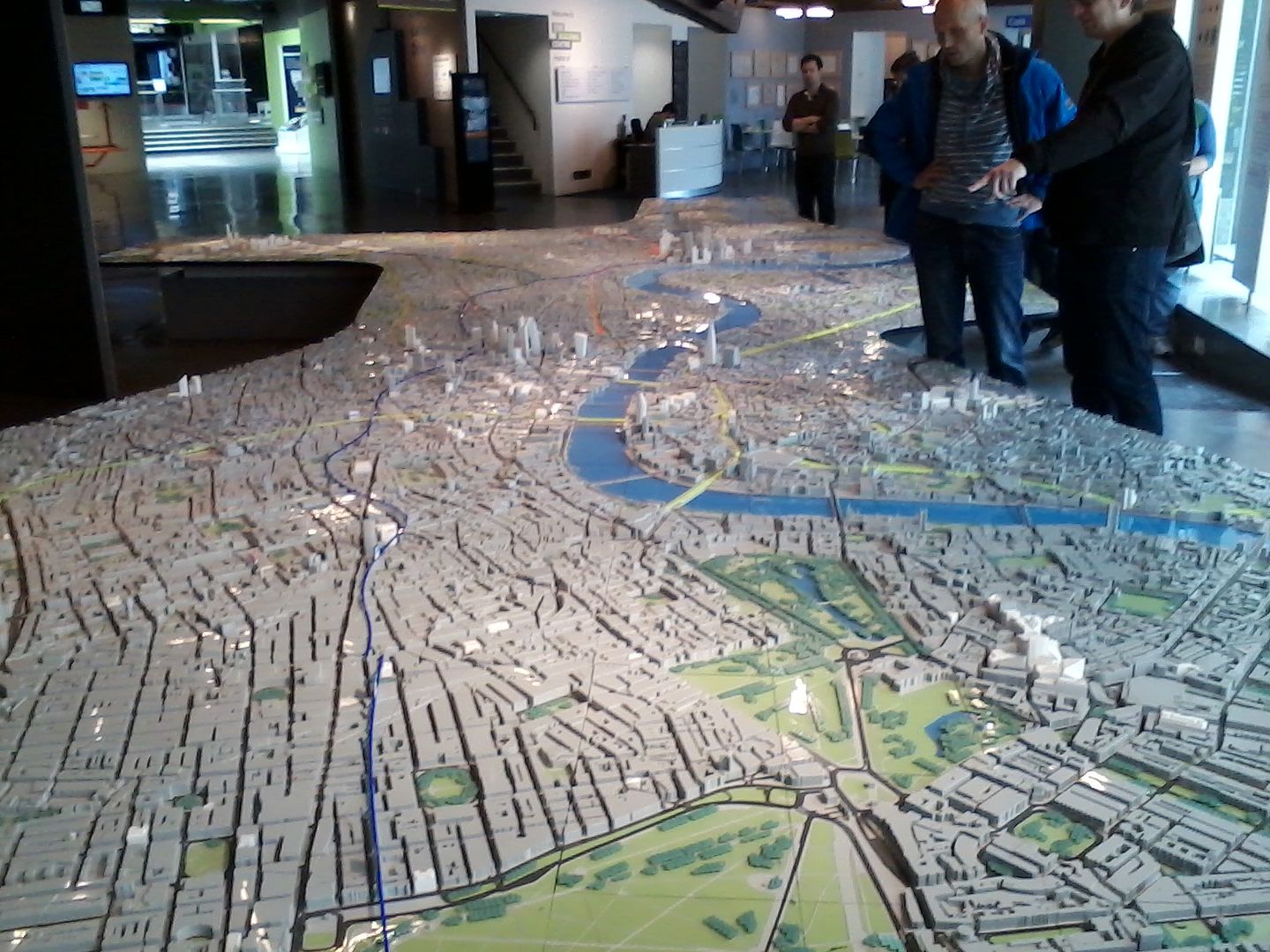
From there, we strolled in the direction of the New London Architecture Centre, where they were having an exhibition called Planes, Trains and Drains, on urban planning for London and the surrounding areas.   They'd evidently used the hosting of the London Olympic Games to achieve a number of infrastructure improvements, and the scope (plans that would require revision and extension in 2031 were 'short term') was very impressive.  In particular the recognition that improving transport would require not only changes to the transport network, but to foot and car traffic areas in the areas that were getting better service.

They had an impressive model of the city of London:

And are devoting considerable effort toto low rise urban development and increased density.   They're also in the process of updating the amazing Victorian sewer system (developed by Joseph Bazalgette) and already carrying much more than the capacity it was designed for.   (If you're starting to wonder about people who are so enthused about drainage, all I can tell you is that we're both engineers. Using technology to solve problems excites us.)

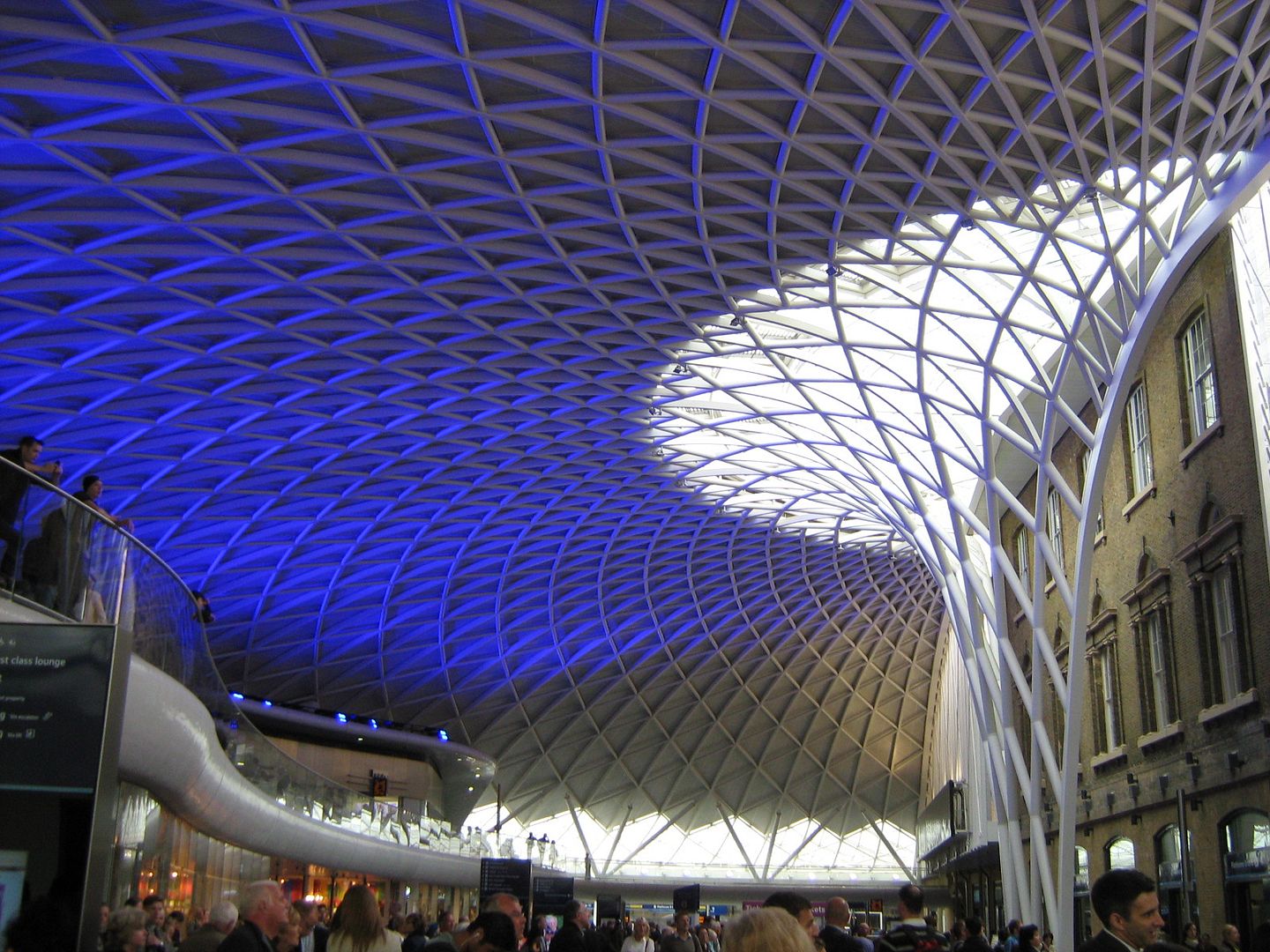
From there we went back out into the brilliant sunshine and walked up to Kings Cross to see the new renovation there.  It had been featured in the exhibition we'd just seen, and the station had been thoroughly torn apart during our last visit, so we were quite curious. It proved spectacular- they've roofed over a bunch of open areas, keeping the existing station facade, but adapting it into an extensive area of shops and restaurants, a bit similarly to the design of the huge covered courtyard of the British Museum. 

And the British museum was where we headed next.  We were disappointed to find that the Ice Age exhibition (one of two current special exhibitions) was sold out, but not so disappointed we were willing to throw money at the problem (we could likely have gotten in by becoming museum members...which we would have happily done, were we able to visit more often than once every few years).    Instead we walked through the exhibition on the Enlightenment, which was rather apt given how much of the early part of our trip involves the naturalists and collectors of the Enlightenment.

After the museum, some more strolling took us to Busaba Eathai (a longtime favorite of ours) for dinner, and then to Waterloo station to catch the train down to Dorchester, where we were staying for the first few days of our trip.

Here are a few more photos from our first day in London:
rfholly's Day 1 album on Photobucket